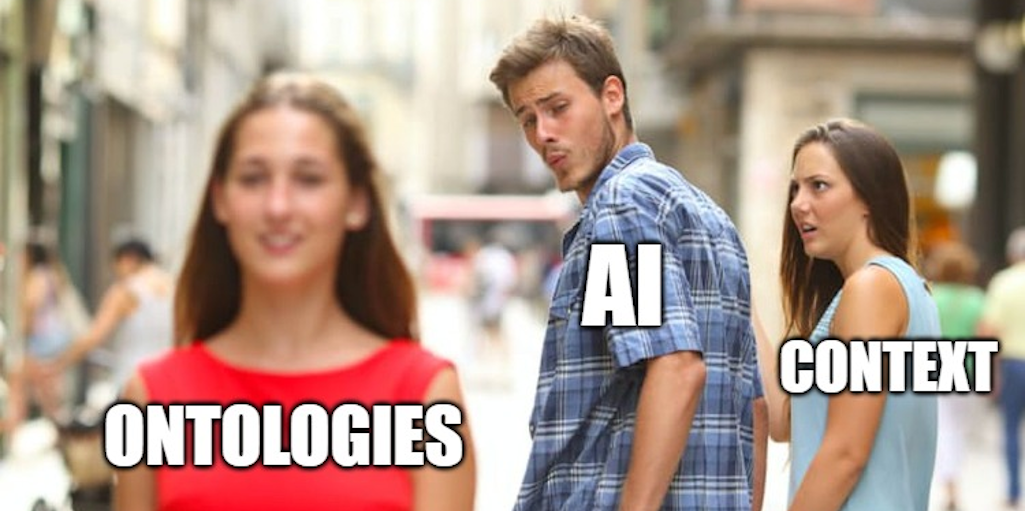
The grand version of the semantic web didn’t happen. A narrower version of it turned out to be a good fit in regulated finance.
A while back, in a piece about agents, I dropped a comment while listing the technologies that have each had a turn (e.g., expert systems, neural nets, rule engines): “Ontologies (remember those? Well… it’s coming back. That’ll be a separate blog).” This is that blog.
2 different things travel under the word “ontology,” and only one of them has a future. There’s the ambitious one: formal logic, automated reasoning, machines inferring facts nobody stated. And, there’s the humble one: an agreed vocabulary, a set of stable identifiers, a way to record what a column means so that two systems don’t have to hold a meeting about it. The ambitious one is roughly where it was twenty years ago: academic, brittle, confined to narrow domains. The humble one is quietly working in the most regulated industry we have. This post is about the second one, and about why the difference is easy to miss.
Promise that didn’t land
If you weren’t in the room for it, here is what we were told around 2005. The web, as it existed, was a pile of documents written for humans. The next web, Web 3.0 (with capital-W), in the original Tim Berners-Lee vision, would be written for machines. This was before the phrase (Web3) was repurposed to mean cryptocurrency.
In Web 3.0, every page would carry structured meaning. Data would describe itself in Resource Description Framework (RDF). Reasoners would chew through Web Ontology Language (OWL) ontologies and infer facts nobody had stated. The integration problem would dissolve. That the eternal tax on every enterprise, the reason two systems that both know what a “customer” is still can’t agree on one. The grand vision that everyone would finally be speaking a shared, formal vocabulary. It was a coherent idea, and the underlying technology was real. RDF works. SPARQL works. OWL expresses things you genuinely cannot express in a relational schema. The easy posture couple of decades on is to sneer, and sneering is lazy. It also landed with a thud.
Human language still have this problem. With the same shared language, we still manage to misunderstand each other all the time. It’s grand vision and not an easy problem to solve.
| The 2005 promise | What actually happened |
|---|---|
| Machines will read and reason over the web | Humans still read the web; machines mostly index it |
| Every page carries RDF; the web becomes one global database | A few pragmatic vocabularies stuck; the grand vision never shipped |
| Reasoners infer new knowledge at scale | OWL reasoners stayed brittle and academic outside narrow domains |
| Shared ontologies dissolve the integration problem | Ontology authoring became its own cottage industry of well-paid toil |
If that outcome pattern looks familiar, it should. In Déjà vu I put Enterprise SOA on a similar table just like this one, and gave it a verdict of MOSTLY NO: the idea was right; the implementation was strangled by governance and tooling. The semantic web earned the same verdict for the same reason. Both were undone not by a flaw in the concept but by the human cost of the bureaucracy required to make the concept real. Somebody had to author the ontologies, maintain them, and convince forty teams to agree in writing on what a “party” was. That somebody was expensive, the work never ended, and the payoff was always one more committee away. So the loud voices moved on. “Semantic web” went the way of “Service-Oriented Architecture,” not disproven, just unfashionable, which is a different and less honest kind of ending.
At one point in my career, I served on a business capability taxonomy committee, representing Asset Management. Our task sounded simple: agree on common terminology across Asset & Wealth Management, Corporate & Investment Banking, and Retail Banking. Predictably, Asset Management and Corporate & Investment Banking aligned; they both operate in an institutional world. Wealth Management and Retail Banking aligned as well; focused on individuals. The difference between institutional and individual was a chasm. We still spent weeks debating what something as basic as
Lead,Prospect, andClientactually meant.
It’s back?
The semantic web didn’t die everywhere. It died on the open, consumer web; in the place it was loudly sold. To be fair, many still don’t understand semantic web. However, a small portion was persisting, slowly and without fanfare, in enterprise data governance, where it had never been hyped enough to crash. Can you really say “it’s back” when it never truly left – you just had to look for it. It’s closer to a bifurcation: one area it failed, and another it quietly kept working.

And the toolkit you find is mostly the humble sense of the word, not the ambitious one. The Financial Industry Business Ontology (FIBO), maintained by the EDM Council, is a real. Formal ontology practice in most institutions use it as a shared dictionary of financial concepts rather than a live reasoning engine. The Legal Entity Identifier (LEI) is barely an ontology at all. It’s a global, machine-resolvable identifier, a numbering scheme that exists because the 2008 crisis ended with regulators unable to answer “who owes what to whom.” The Data Privacy Vocabulary turns a GDPR record-keeping obligation into a graph a machine can check. Data Catalog (DCAT) and Comma Separated Values on Web (CSV-W) vocabularies describe datasets and their structure so that other systems can consume them without a conversation. Useful, unglamorous, and mostly about agreed meaning.
Why it stuck around
Two things kept it alive here, and I want to handle both carefully, because the careless version of either is the kind of overclaim these posts exist to push back on.
The first is regulation, which does something hype cannot: it removes the choice. Shared, formal meaning is a public good; everyone benefits. Nobody wants to fund the authoring, so on the open market it doesn’t get authored. Regulation breaks the stalemate by making agreed definitions mandatory. The cleanest example is the LEI: after 2008 you did not get to decide whether your counterparties had a common identity. BCBS 239 is a looser case, and worth being honest about. It requires accurate, fast risk-data aggregation, not an ontology specifically, and plenty of banks meet it with a warehouse, master-data management and a dictionary. So the honest claim is a narrow one: regulation made agreed meaning not optional, and formal vocabularies are one durable way to supply it.
The second is more speculative, and my own opinion. The thing that made ontologies miserable was the authoring toil/cost. Few truly understand it and even fewer can author it properly. The manual labor of writing and reconciling formal vocabularies; the standing committee that never disbands. Like most committees, take a long time to build a consensus. This is the kind of work a language model can take a real bite out of: drafting a candidate mapping from a column to a financial concept, flagging where two schemas disagree, producing a first-pass classification. I don’t have adoption numbers showing this is already reshaping the field, so treat it as a plausible guess, not a confirmed one. And note the limit: a model proposing FIBO mappings will return confident, wrong identifiers. It did exactly that in the work that prompted this post so a human still checks every line. Human in the middle will never scale.
There’s a sharper objection inside that second point. Why maintain an explicit dictionary if the model can map “cust_nm” to “customer name” on the fly? My answer is that it depends on the stakes. On a casual task, letting the model route around the vocabulary is fine. In an audited, regulated workflow you want the deterministic, checkable spine precisely because the model is probabilistic. You need to prove what a field means, not ask a model to guess well. So the case for formal semantics isn’t general. It’s strong exactly where the consequences are high and the auditor is real, and weak elsewhere.
Why it matters
It’s worth being precise about what “understanding” the data even means here. The word claims more than the technology delivers. A capable model already pattern-matches column meaning from training; show it cust_nm and it will usually land on “customer name.” What a controlled vocabulary adds isn’t comprehension; it’s the replacement of a good guess with a declared, stable, checkable denotation. The agent stops inferring that bal is a monetary amount and instead reads that the column is bound to a specific financial concept, in a stated currency, as of a stated date. The shift is from “the agent interprets well” to “the agent acts on a fixed meaning it can verify.” For a chatbot that distinction is cosmetic. For an Agent AI it’s the entire point, because an agent acts.
And the cost of a wrong interpretation scales with the ability to take action on it. A model that misreads bal in a chat window gives you a slightly wrong sentence. An agent that misreads it sums across currencies, or emails the figure to a counterparty, or slips a restricted field into an export. The vocabulary converts “probably right” into “checkably right” at exactly the boundary where wrong stops being cheap. It hands the agent a hard, machine-readable signal. This field is personal financial data, the policy forbids sending it outside. This is a control loop that can check before it acts, rather than a confident guess that fails in the open on the hundredth case.
There’s a second effect that’s easy to miss, and it’s one I raised when writing about agents: the answer at step n changes what the agent does at step n+1. The flip side is that a misread early on poisons everything downstream, silently, because the model’s own confident guess is the only ground it has to stand on. Pinning meaning to a stable referent at each hop is error-correction that stops the compounding. The ontology is the fixed point the reasoning loop can’t quietly drift away from over a long run.
I’ve had this debate with product and business more times than I can count: confidence scores are meaningless. A liar can sound certain, and an AI can be completely wrong with absolute confidence.
The vocabularies map onto the things an agent actually has to do. It has to find the right dataset and know whether it’s even permitted to touch it; DCAT and its access rights. It has to read the data correctly. Schema.org for the generic shape it already has priors for. FIBO for the financial substance it doesn’t. The part that tells it not to average a column of identifiers or add up amounts in different currencies. It has to handle the data lawfully: Data Privacy Vocabulary (DPV), the layer recording which fields are personal or financial, on what basis, for which purpose. And because each of those denotations is a stable identifier rather than a local string, 2 datasets that bind “the legal entity” to the same one become joinable without the agent re-deriving the mapping every time. This is what lets one agent’s output feed another without a translation step that can hallucinate on its own.
What makes this safe rather than merely convenient is verifiability. The vocabulary isn’t only grounding for the input; it’s the thing that catches the model when it returns a confident, wrong answer. The plausible-but-invalid identifier a validator can reject outright. And because the agent’s choices trace back to published terms, you can replay and explain why it treated a field as personal financial data: it followed the declared tag, not a hunch. In a regulated setting that isn’t a nicety, it’s the difference between an automated decision you can defend and one you can’t. Which scopes the claim the same way the rest of this does: a strong enough model routes around all of it on casual work, and there the vocabulary is dead weight. The value concentrates where the agent can act, the stakes are high, and the auditor is real. The same place the rest of the stack survived. The agentic angle isn’t a separate story; it’s the one with the volume up. The more capable and autonomous the agent, the more it needs a deterministic, checkable spine, because the cost of its confident mistakes rises faster than its accuracy does.
Outcome
So let me retire my own side remark properly. Ontologies aren’t “coming back” in the sense that word implies. A specific, working part of the idea turned out to be durable in a specific, demanding place, for reasons that owe more to regulation and accounting than to the original vision. We declare a technology a failure at the bottom of its hype cycle and stop looking, which means we miss when it pivots.
The technologies that relocate rather than die tend to share a trait: they solve a coordination, identity or provenance problem that regulation later makes mandatory. The ones that don’t clear that bar mostly just end. That also doubles as a test for the claim I’m making here. If you can’t point to a specific obligation that forces agreed meaning, be suspicious of anyone telling you the semantic stack is thriving. None of which means ontologies won anything. They didn’t. They survived where they were needed, which is a quieter result than a victory.
In part 2, I’ll demonstrate, layer by layer, how ontologies gives AI a deterministic spine.
