
I’ve lived through 25+ years of technology hype cycles, and what they (and don’t) tell us about the one we’re living through now.
There is a particular kind of meeting that happens in technology organizations at the peak of every hype cycle. The room is full of smart people. There is a slide deck. Someone presents a technology that is going to change everything; not incrementally, not in some narrow domain, but fundamentally, at the root, in ways that will render existing patterns of working obsolete within a measurable timeframe. The questions from the room range from credulous to breathless. The skeptics stay quiet, because skepticism in that room, in that moment, reads as defensiveness. As fear. As someone protecting a professional identity that is about to become irrelevant. I sat in that room, not for all of them but some of them. I have been sold the idea in that room. I’ve also been the quiet skeptic. And I’ve been in enough of these that I’ve walked away thinking: Déjà vu.
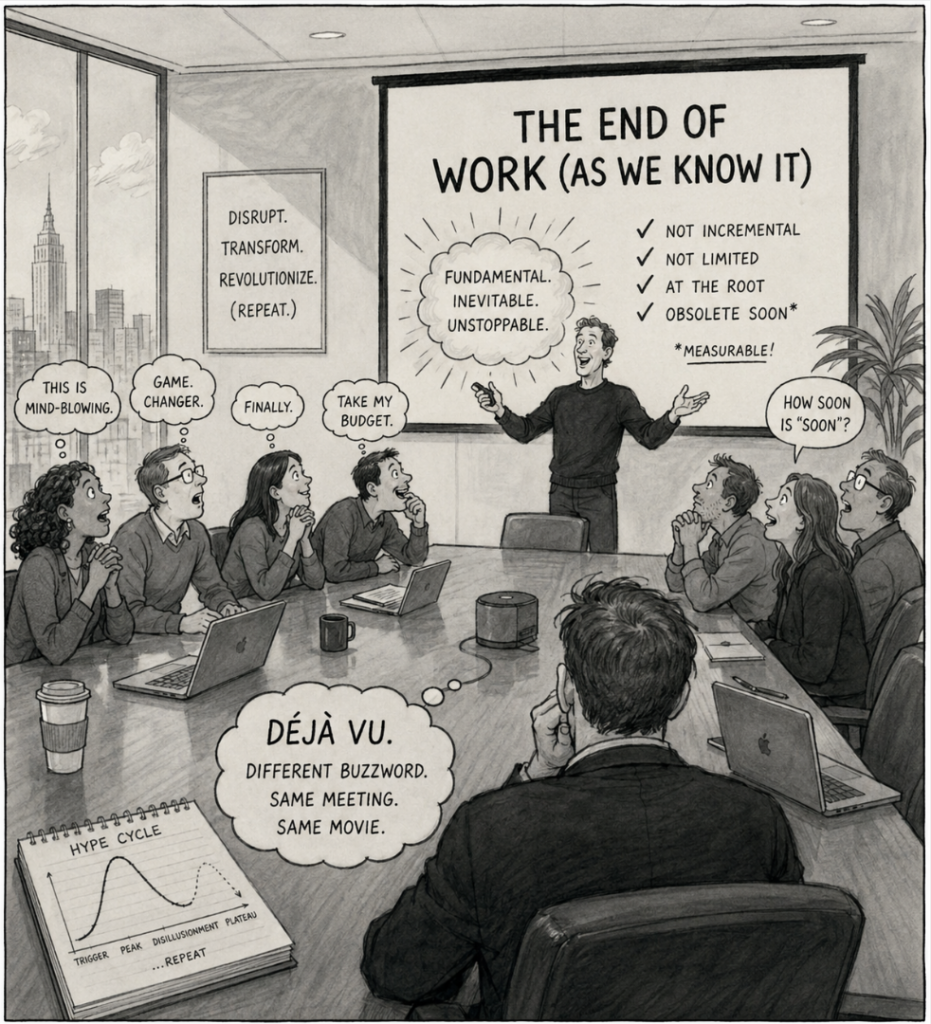
What follows is not a dismissal of the current AI moment. I should make clear that I take these systems seriously. But taking something seriously does not require abandoning the pattern recognition that comes from watching this industry for a long time. And the pattern, right now, is worth examining.
The Inventory
Let me do something I have not seen done often enough in discussions of AI: put the current moment in a table next to its predecessors. Not to mock the earlier cycles, many of them produced real lasting value, but to look clearly at what the anatomy of a hype cycle actually is, and where we are in this one.
| Era | The Claim | What Actually Happened | Verdict |
|---|---|---|---|
| Dotcom 1995-201 | “Every business will be replaced by its internet equivalent. Physical retail is over. Old-economy companies will not survive.” | Most pure-play internet companies failed spectacularly. Physical retail did not die. The internet did, however, quietly restructure every industry over the next twenty years; just more slowly, partially, and unevenly than advertised. | PARTIAL |
| Enterprise SOA 2003-2008 | “Service-Oriented Architecture will allow organizations to compose enterprise software like LEGO bricks. Reusability will solve the integration problem.” | SOA produced an enormous amount of XML, a generation of middleware vendors, and integration complexity that was in many cases worse than what it replaced. The idea was right; the implementation was strangled by governance and tooling. Its successor, microservices, made the same promises a decade later. | MOSTLY NO |
| Mobile Revolution 2007-2014 | “Mobile will kill the desktop. Every experience must be rebuilt mobile-first. The PC is dead.” | Mobile genuinely transformed entire categories of human behavior – navigation, communication, commerce, photography. The PC did not die. Desktop development remained a large and viable profession. Both coexist. The transformation was real and large but not totalizing. | LARGELY YES |
| Big Data 2011-2016 | “Data is the new oil. Organizations that collect and analyze enough data will develop sustainable, insurmountable competitive advantages.” | Data analytics created real value at scale. The “new oil” metaphor turned out to be apt in an unintended way: messy, expensive to refine, and concentrated in the hands of a small number of very large players. Most organizations’ “big data” initiatives produced dashboards that nobody looked at. | PARTIAL |
| Blockchain 2017-2022 | “Distributed ledgers will disintermediate banks, governments, and every trusted third party. The entire financial system will be rebuilt on trustless protocols within a decade.” | Cryptocurrency exists and is volatile. Blockchain in enterprise produced a large number of pilot projects that were quietly discontinued. The underlying technology has some genuine uses. The transformation of global finance did not occur. | NO |
| Metaverse 2021-2023 | “Work, social interaction, commerce, and entertainment will migrate to persistent 3D virtual worlds within five years. Physical space will become less central to human experience.” | Meta wrote down $40 billion. The devices were heavy. The experiences were lonely. VR gaming is a real niche. The metaverse as described did not materialize on any timeline resembling what was promised. | NO |
| Generative AI 2023- | “AI will automate knowledge work, replace programmers, writers, lawyers, and doctors, and restructure the global economy within a few years.” | Still writing the ending. But the capabilities are real, the trajectory is not obviously slowing, and the systems are being embedded in production at a pace that is different in character from previous cycles. | TBD |
What Hype Cycles Have in Common
Look at the table long enough and some structural features emerge. They are not accidental.
1. The Technology Is Usually Real
This is the first thing to get straight. None of the cycles above were based on pure fiction. The internet did transform commerce. Mobile did change how humans navigate and communicate. Data does create competitive advantages, in some cases and at some scales. The technology at the center of each cycle was typically doing something real and interesting. The failure was in the prediction, not the phenomenon. This matters for the current moment because “the technology is real” is not a sufficient argument for “the claims are proportionate.” The internet was real in 1999. That did not make Pets.com a sound investment.
2. The Most Extreme Claims Arrive Before the Constraints Are Understood
Every cycle follows the same universal arc. Early on, the technology’s capabilities are visible but its limitations are not; not because they are hidden, but because the use cases that would expose them have not been tried yet. The loudest claims are made in this window. By the time the constraints become clear (the reliability issues, the cost structure, the edge cases, the regulatory friction, the organizational inertia) the loudest voices have often moved on to the next thing, or have reframed the original claim in ways that make it unfalsifiable.
I watched this happen with enterprise SOA in real time. The claims were made in 2003. The enterprise architects who made them were, in many cases, still making them in 2008, while simultaneously beginning to use the word “microservices.” The original prediction did not become falsified. It became unfashionable, which is a different thing and a less honest resolution. Seriously, when was the last time you heard anyone say “Service-Oriented Architecture”?
I believe microservices are at their tail end. Don’t believe me? Try googling
monolith are back.
3. The Productivity Gains Are Real but Narrower Than Advertised
Here is the pattern that I find most consistently true across cycles, and most relevant to the current one: the technology produces genuine, significant productivity gains in well-defined, bounded domains. It produces much less, or nothing, in domains where the problem involves tacit knowledge, contextual judgment, organizational dynamics, or the kind of accountability that requires a human face.
4. The People Most Affected Are Rarely the Ones Making the Predictions
This is uncomfortable to say, but I think it is true and worth saying: the boldest predictions about technological disruption tend to come from people who will not personally experience the disruption they are predicting. Venture capitalists predicting the death of knowledge work are not themselves knowledge workers whose jobs are at risk. Engineering leaders presenting AI transformation roadmaps are, in most cases, several layers of management above the engineers whose roles they are describing as about to change. I include myself in this critique. My perspective on what AI will “replace” is shaped by what I observe from where I sit, which is not the same as where most engineers sit. The obligation, when making claims about transformation, is to think carefully about whose transformation you are actually describing, and whether you would make the same prediction if it were your role on the line.
What Is Different This Time
Having lived through the patterns of hype cycles, I want to be honest about what makes the current one different in some respects. I am not the first person to say “this time is different”, that phrase has its own dismal track record, but I think there are genuine asymmetries worth naming.
The Feedback Loop Is Faster
Previous technology cycles moved through organizations slowly. Enterprise SOA required consultant engagements, procurement cycles, and multi-year integration programs. Mobile required new hardware, new development platforms, and time for user behavior to shift. The current cycle has a different property: the marginal cost of trying a new AI capability is close to nil, and the feedback arrives in minutes, not months.
Read my post on Goodhart’s Law. “4 of the largest technology companies on earth hit that moment more or less simultaneously…[they] shut down an internal AI leaderboard… ranking developers by how many AI tokens they consumed”
This changes the pattern. In previous cycles, you could debate the claims for years before the evidence accumulated. With AI, anyone can run the experiment tomorrow. The sample sizes are growing rapidly, and the community’s understanding of what these systems can and cannot do is, accordingly, growing rapidly. This is genuinely different from the SOA era, where the evidence against the claims took years to become legible.
The Capabilities Are General-Purpose in a New Way
The internet was general-purpose, but its generalness expressed itself through specific applications: e-commerce, email, search. Mobile was general-purpose, but its generalness expressed itself through the app store model, a large number of specific applications downloaded on demand. Both required someone to build the specific application that matched your specific need. Language models are general-purpose in a different way. They operate on language, and language is the substrate of almost all knowledge work. You do not need a specific app to be built. You describe what you need. This is not a trivial difference. I am not sure we fully understand its implications yet, and I say this as someone who remains uncertain about a great many things in this domain.
Because LLM are inherently general-purpose, they need to be augmented with domain-specific capabilities to operate effectively within an enterprise context. Their strength comes from training on massive datasets (essentially a broad corpus of the internet) grounded in principles like the Law of Large Numbers and the Condorcet Jury Theorem, both of which reflect a form of “wisdom of the crowd.” This is I agree with Ben Affleck on quality of what LLM produces. Because it goes to the means, its outputs not that great.
The Deployment Velocity Has No Precedent
In 2022, the majority of software engineers had not used a large language model for anything. By 2024, the majority were using one regularly. I do not know of another technology, including the smartphone, that achieved that level of professional penetration in that timeframe. This does not tell us about the long-run impact. Adoption velocity and transformative impact are different metrics. But it does mean the feedback loop I described above is running faster than any previous cycle.
What the Pattern Tells Us to Watch For
I am not going to predict where this cycle ends. I have watched too many confident predictions dissolve to offer one myself. What I can offer, from the inventory above, is a set of questions that historically distinguish transformations that stick from transformations that shrink back to their actual size.
Where are the constraints showing up? Every cycle has them. The question is whether the constraints are engineering problems that will be solved with more scale and time, or whether they are structural; related to the nature of the task rather than the maturity of the technology.
Who is doing the work that the technology is supposed to eliminate? When you look at the actual workflows in organisations using AI extensively, how many of them still have humans doing substantial review, correction, and judgment work? The answer tells you more about the actual state of automation than any benchmark.
What does the cost structure look like at scale? “Transformative” technologies tend to become cheaper over time. If a technology requires persistent high cost to maintain quality (if every output requires expensive human review) the economic case for transformation weakens substantially.
What breaks at the tail? Averages are flattering. The cases that matter for understanding the true scope of a technology are the ones at the margins. The edge cases, the low-frequency high-stakes decisions, the adversarial inputs. How does the system behave there?
What I Actually Believe
I have been careful throughout this post to stay close to observable pattern and away from confident prediction, because I think confident prediction has a poor track record in this domain. But I should be honest about where I actually stand, rather than leaving the reader with a useful framework and no view. I believe the current AI moment is more like the mobile revolution than it is like the blockchain era. The technology is doing something real. The transformation is genuine but will be slower, more partial, and more domain-specific than the loudest voices are currently claiming. The people and roles most at risk are not primarily engineers, who have historically been among the best at absorbing new tools and turning them into leverage, but rather the roles that involve high-volume, well-specified cognitive work that does not require accountability, judgment, or client-facing responsibility. Legal review. First-pass code generation. Documentation. Pattern-matching in large datasets. These are real, large categories, and the disruption there is not speculative.
What I do not believe: that this cycle will play out on a 2-3 year timeline – unfortunately, we already midway through this. I have watched every cycle take longer than predicted at the ambitious end and deliver more than predicted at the skeptical end. The realistic range is wider than most of the confident voices in either direction are willing to acknowledge. And I believe (this is perhaps the thing I believe most firmly, because it is the thing the pattern most consistently supports) that the engineers and leaders who will navigate this transition best are not the ones with the most confidence about where it ends. They are the ones who are good at running experiments, reading evidence honestly, updating their views when the evidence changes, and resisting the social pressure, in both directions, to perform a level of certainty they do not actually have.
